Most people know what dry ice does. It keeps shipments frozen, creates fog at events, and cleans machinery without water. Far fewer people know how it is actually made, and that gap costs buyers money. The way dry ice is produced decides how dense it is, how long it lasts, and how much of your order turns to gas before you even use it.
If you are choosing a dry ice manufacturer in the UAE, understanding the process gives you the right questions to ask and the right quality signs to look for. This guide walks through every stage, from raw carbon dioxide to the pellets and blocks delivered to your door in Dubai.
What Is Dry Ice?
Dry ice is the solid form of carbon dioxide (CO2). It never melts into a liquid. Instead it sublimates, which means it turns directly from a solid into gas, at about minus 78.5 degrees Celsius. That extreme cold is why dry ice cools far more powerfully than water ice, and why it leaves no wet mess behind.
That same property is also why freshness matters so much. Dry ice starts turning back into gas the moment it is made.
How Dry Ice Is Made: The Process in Six Steps
Step 1: Sourcing Carbon Dioxide
Dry ice does not start as a new chemical. It starts with CO2 that industry already produces, for example during ammonia and fertilizer production, ethanol fermentation, hydrogen production, and natural gas processing. Instead of letting this gas escape into the air, producers capture it. The cleaner the source, the better the finished dry ice, which matters most for food and medical use.
Step 2: Purification
Captured gas can carry moisture, traces of oil, and odor compounds. Manufacturers pass it through filters, dryers, and scrubbers to remove them. When this stage is rushed, the result is dry ice that smells odd or falls short of food-grade expectations.
Step 3: Liquefaction and Storage
The purified gas is compressed and cooled until it becomes liquid CO2, then held in insulated pressurized tanks. Storing it as a liquid lets a plant keep a steady supply ready, so production can follow customer demand instead of stopping and starting.
Step 4: Expansion Into Dry Ice Snow
Liquid CO2 is released into a chamber at much lower pressure. The sudden pressure drop turns part of the liquid into gas, and that rapid expansion chills the remainder so sharply that it freezes into a fine white powder, often called dry ice snow. The leftover gas can be captured and reused.
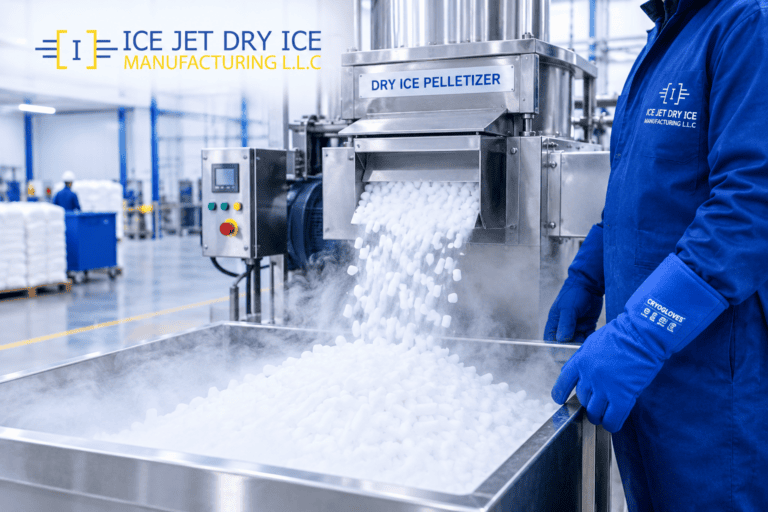
Step 5: Pressing Into Pellets, Blocks, and Slices
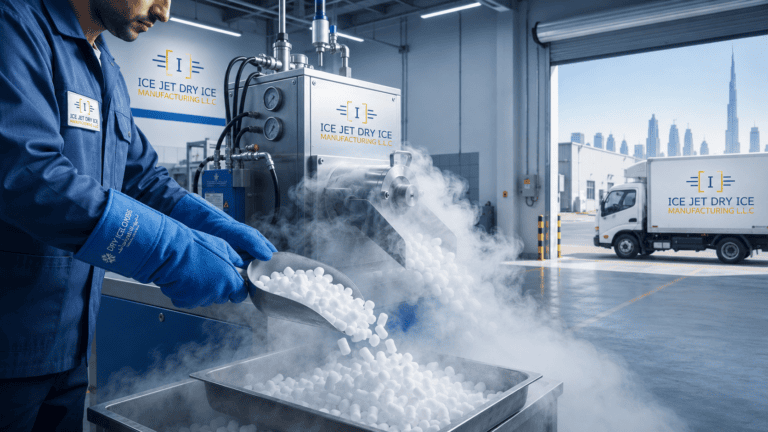
Dry ice snow is loose and unstable, so a hydraulic press compacts it. Pushing the snow through a die plate forms pellets, and the size of the die opening sets the pellet diameter. Pressing it into a larger chamber forms solid blocks, which can be cut into slices. The pressure applied here sets the density, and density is the biggest factor in how slowly dry ice sublimates.
Step 6: Packing and Dispatch
Because sublimation begins immediately, the last step is a race against time. Fresh product goes into insulated containers and is dispatched quickly. The shorter the gap between pressing and delivery, the more usable dry ice you actually receive.
Pellets, Blocks, and Slices: Which Shape for Which Job?
The shape a manufacturer presses is not just a matter of preference. Smaller pieces have more surface area and turn to gas faster, while larger pieces last longer. Here is how the common sizes are typically used:
- 3 mm dry ice pellets: the standard choice for dry ice blasting and precision cleaning. If you want to see how this works in practice, read our guide on how dry ice blasting works.
- 6 mm and 10 mm pellets: flexible sizes for general cooling, packing around goods, and effects.
- 16 mm dry ice pellets: popular for shipping, cold chain packing, and events.
- 20 mm and 30 mm blocks and slices: the best fit when you need long-lasting cooling in large coolers, bulk storage, or long-distance transport.
Choosing the wrong size is one of the easiest ways to waste money, which is why a good manufacturer will ask what you are using it for before recommending a product.
What Makes Good Dry Ice? Four Quality Signs
Now that you know how it is made, you can judge what you receive.
- Density. Well pressed dry ice is hard and dense, and it does not crumble easily when scooped. Soft, powdery product has been under pressed and will disappear faster.
- Purity. Clean dry ice is white and has no unusual smell. Odor or discoloration points to a weak purification stage.
- Consistent size. Pellets and blocks should be uniform from one delivery to the next. Big swings in size suggest an unstable process.
- Freshness. Recently pressed product gives you more usable weight and a longer working time.
Always handle dry ice with insulated gloves and never with bare hands. Our guide on how to safely store and handle dry ice in the UAE covers the essentials.
Why Freshness Matters Even More in the UAE
In a hot climate, sublimation runs faster. Summer temperatures, vehicles parked in the sun, and long delivery routes all increase the amount of dry ice lost before it reaches you. Even in a well insulated container, no dry ice lasts forever, which is why the distance between production and delivery matters. You can learn more in our article on how long dry ice lasts in an insulated box.
This is also why many UAE businesses now order close to the time of use rather than stockpiling. Our post on on demand dry ice in Dubai versus storage explains the reasoning.
How to Check Whether a Dry Ice Manufacturer Is Genuine
Any company can call itself a manufacturer. These questions separate real producers from resellers:
- Do you press the dry ice yourselves, at your own facility?
- When was this batch pressed?
- What CO2 source and purity level do you use?
- Which pellet and block sizes do you keep available every day?
- How is the product packed for delivery in hot weather?
A genuine manufacturer answers these quickly and clearly. For a deeper look at the difference, read our comparison of a dry ice manufacturer vs a dry ice supplier in Dubai, and see why businesses prefer certified dry ice manufacturers in the UAE.
Dry Ice Made in Dubai by IceJet UAE
Ice Jet Dry Ice Manufacturing LLC produces dry ice at our facility in Al Quoz Industrial Area 4, Dubai. Our range covers 3 mm, 6 mm, 10 mm, and 16 mm pellets, plus 20 mm and 30 mm blocks and slices, so you can match the product to the job. You can see the full range on our dry ice products page, learn more about our background on the About page, or read our buyer’s guide to dry ice suppliers in Dubai and the UAE.
We deliver across Dubai and the wider UAE, and because we produce the dry ice ourselves, you get product that is pressed close to the time it reaches you.
Frequently Asked Questions
How is dry ice made? Dry ice is made by capturing and purifying carbon dioxide gas, turning it into liquid CO2, expanding it into a fine snow, and pressing that snow into pellets, blocks, or slices with a hydraulic press.
What is dry ice made from? Dry ice is made from carbon dioxide. The CO2 is usually captured from industrial processes rather than produced specially for dry ice.
Is dry ice made in the UAE? Yes. Local manufacturers in Dubai press dry ice on site, which shortens the time between production and delivery. This is an advantage in hot weather, when dry ice sublimates faster.
Why does dry ice need to be fresh? Dry ice turns into gas continuously from the moment it is pressed. Fresher product means more usable weight and longer cooling time for your shipment or event.
Can dry ice be made at home? No. Making dry ice requires liquid CO2, pressure equipment, and a press. It is not safe or practical to attempt at home, so it is best bought from a trusted local producer.
Need fresh dry ice from a local producer? Contact IceJet UAE for pellets, blocks, and fast delivery across Dubai and the UAE. You can also explore our dry ice in Dubai page or find dry ice near you in the UAE.