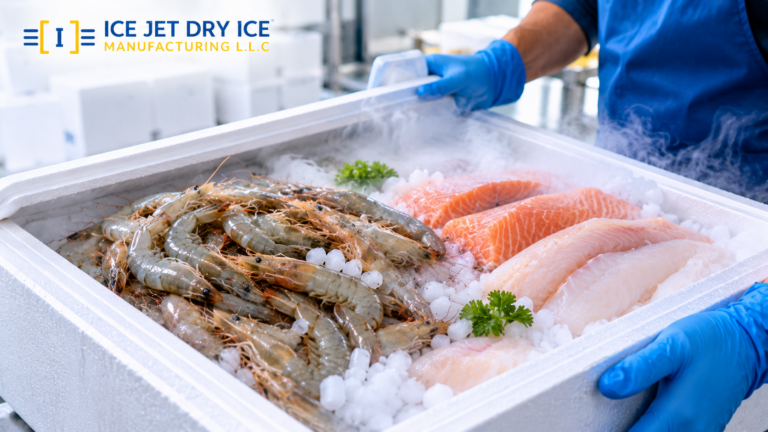
A seafood distributor loads frozen prawns into a van at midday in Dubai, with a two-hour drive ahead and summer temperatures that can pass 40°C. By the time the doors open at the customer’s cold room, the only question that matters is whether the product is still as cold as it was at dispatch. For many suppliers, dry ice for seafood shipping UAE operations is the practical answer, because it holds shipments at far lower temperatures than regular ice. If you are new to dry ice for shipping in Dubai and UAE, this guide explains how it works, how to pack it, how to plan quantities and how to handle it safely.
Why Temperature Control Matters in Seafood Transportation
Seafood is one of the most temperature-sensitive products in the cold chain. Fish and shellfish spoil quickly once they warm up, and bacterial growth, texture loss and off-flavours can follow long before the product looks obviously wrong. Frozen seafood that partially thaws and refreezes also loses quality, even if it never reaches the customer in an unsafe state.
In the UAE, the risk begins before the vehicle even moves. Loading docks, car parks and delivery points can be extremely hot, so every minute a box spends outside cold storage counts. Long-distance routes, border or airport handling and delivery delays add to the exposure.
Temperature control is therefore a planning exercise, not a last-minute add-on. Good insulation, realistic journey times and a clear cooling plan matter as much as the refrigerant itself.
Why Do Businesses Use Dry Ice for Seafood Shipping?
Dry ice is solid carbon dioxide, and it sits at roughly -78.5°C. That is far colder than regular ice, which is why it is commonly used for shipments that must stay frozen rather than simply chilled.
Instead of melting, dry ice undergoes sublimation: it turns directly from solid to carbon dioxide gas. This means it leaves no liquid water behind, so boxes stay dry, packaging is less likely to weaken and seafood does not sit in meltwater.
Compared with regular ice, dry ice may be more appropriate when:
- the product must remain frozen throughout transit;
- the journey is long or delays are possible;
- water leakage would damage packaging or other goods;
- space and weight are limited, since the cooling power per kilogram is higher.
Regular ice still has a place for fresh, chilled seafood where freezing is not wanted. The right choice depends on the product and the route. Businesses exploring dry ice solutions for the food industry often start by deciding whether their shipment needs to be frozen or only kept cool.
How to Pack Seafood with Dry Ice for Transportation
Good packing is what turns dry ice into a dependable cooling system. A typical process looks like this:
- Choose suitable insulated packaging. Thick-walled insulated boxes or containers work best. Avoid packaging that cannot tolerate very low temperatures.
- Prepare the seafood. Frozen seafood should already be at its required storage temperature, and products should be sealed in leak-proof, food-safe bags or wrapping.
- Select the dry ice format. Pellets, blocks or slices suit different box designs (more on this below).
- Position the dry ice. Cold gas sinks, so many packers place some dry ice above the product as well as around it. Fill empty space so the load cannot shift.
- Prevent direct contact. Use a layer of cardboard, paper or a separator between the dry ice and the seafood to avoid freezer burn and unwanted contact.
- Let the gas escape. The box must not be airtight. Carbon dioxide needs a safe exit path, so do not seal the container with tape in a way that traps gas.
- Prepare for loading. Label the package according to carrier and transport requirements, keep it upright and load it quickly into a ventilated space.

How Much Dry Ice Is Needed for Seafood Shipping?
There is no single number that works for every shipment, and any guide that offers one should be treated with caution. The right quantity depends on several factors:
- Quantity and weight of the seafood: a larger thermal mass takes more cooling to keep frozen.
- Container size and design: empty space and box geometry change how efficiently cold is retained.
- Transportation duration: a four-hour delivery needs a very different plan from a multi-day export.
- Outside temperature: a van parked in the Dubai sun is a tougher environment than a chilled loading bay.
- Insulation quality: wall thickness and material strongly affect sublimation rate.
- Handling and delays: extra stops, waiting time at airports or missed deliveries should be built into the plan.
The reliable way to set a quantity is to test your own packaging under realistic conditions, ideally with a temperature logger, and then add a safety margin for delays. Dry ice supplier teams can discuss formats and typical use, but the final quantity should be confirmed by testing your own boxes and routes.
Choosing the Right Dry Ice Format for Seafood Transportation
Dry ice is commonly available as pellets in different diameters, as well as blocks and slices. You can view the available dry ice products in Dubai to compare the options.
- 3mm pellets: very small, with a high surface area. They fill gaps easily around irregularly shaped products, but they sublimate faster.
- 6mm pellets: a popular middle ground for general packing where flexibility matters.
- 10mm pellets: a slightly larger pellet, useful where a bit more mass per piece is wanted.
- 16mm pellets: a larger, slower-subliming pellet that is easier to handle in bigger quantities.
- Blocks and slices: low surface area relative to volume, so they generally sublimate more slowly and suit larger insulated boxes or longer shipments.

The practical trade-off is simple. Pellets pack tightly and cool quickly, while blocks last longer but are less flexible to position. Not every size suits every shipment, so the final selection should depend on your packaging design, the journey and the product.
Common Mistakes to Avoid When Shipping Seafood with Dry Ice
Most problems come from planning, not from dry ice itself. Watch for these:
- Unsuitable packaging: thin or poorly insulated boxes lose cold fast and waste dry ice.
- Wrong quantity: too little means thawing, too much adds cost and gas build-up without benefit.
- Ignoring journey time: plan for the real door-to-door duration, not the ideal one.
- Airtight sealing: sealed containers can build up pressure as the dry ice turns to gas.
- Poor ventilation: in vehicles, cold rooms and warehouses, carbon dioxide can accumulate.
- Inadequate handling precautions: bare-handed contact causes cold burns.
- No temperature monitoring: for high-value or long shipments, data loggers show whether your plan actually worked.
Dry Ice Safety During Seafood Transportation
Dry ice is safe when handled properly, but it demands respect.
- Wear suitable insulated or cryogenic gloves and avoid direct skin contact, which can cause cold burns.
- Handle and store dry ice in well-ventilated areas, because carbon dioxide displaces oxygen in enclosed spaces.
- Never keep dry ice in airtight containers, as the expanding gas can burst them.
- Avoid carrying dry ice in a sealed vehicle cabin; keep the load separate from the driver’s space or ensure strong ventilation.
- Train staff on handling, storage and emergency steps, including what to do if someone feels dizzy or short of breath.
- Follow carrier rules for marking, labelling and declaring dry ice, especially for air freight and export.
Where to Buy Dry Ice for Seafood Shipping in Dubai and UAE?
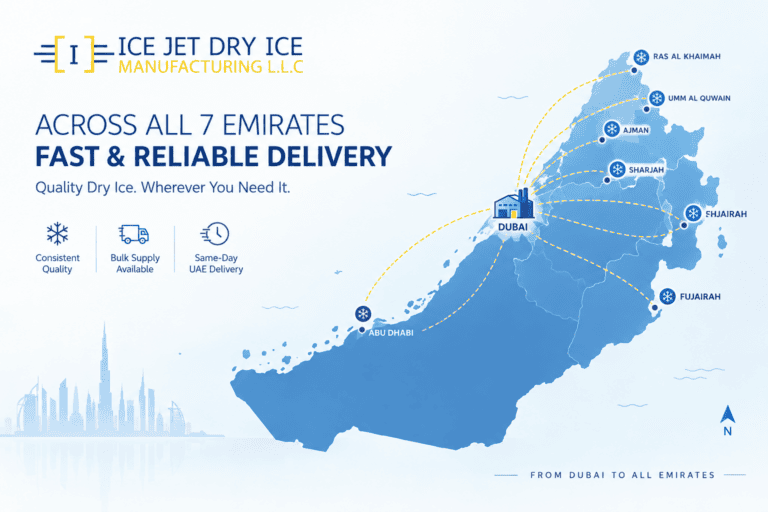
IceJet Dry Ice Manufacturing L.L.C. is a dry ice manufacturer and supplier based in Dubai. The company produces dry ice locally and offers pellets in several sizes as well as blocks and slices, including food-grade dry ice products for businesses that work with food. Supply is available for commercial and industrial requirements, and delivery across Dubai and the UAE can be discussed based on your location and order.
If you need larger volumes, bulk supply enquiries are welcome. A conversation with a dry ice supplier in Dubai can help you match a format to your packaging, volume and delivery schedule.
Frequently Asked Questions
Q. Can dry ice be used for shipping fresh seafood?
It can be, but with care. Dry ice is extremely cold, so fresh seafood that must not freeze needs a barrier and a carefully tested quantity. For chilled products, regular ice or gel packs are often more suitable.
Q. How much dry ice is needed to transport frozen seafood?
The quantity depends on seafood weight, box design, insulation, journey time, and outside temperature. Test your packaging under real conditions rather than relying on a fixed rule.
Q. How long can dry ice keep seafood frozen during transportation?
There is no universal duration. It varies with insulation, quantity, format, and temperature, so use test shipments and temperature loggers to establish your own figures.
Q. Is dry ice better than regular ice for frozen seafood shipping?
For shipments that must stay frozen, dry ice is usually more suitable because it is much colder and leaves no meltwater. For chilled seafood, regular ice may be a better fit.
Q. What type of dry ice is suitable for seafood transportation?
Pellets, blocks and slices are all used. The right choice depends on your packaging, route and product, and a supplier can help you narrow it down.
Q. Where can businesses buy dry ice for seafood shipping in Dubai?
Businesses can buy from a local dry ice manufacturer and supplier such as IceJet, which serves commercial customers in Dubai and across the UAE.
Conclusion
Successful seafood shipping with dry ice comes down to three decisions: the right format, well-tested packaging, and a realistic quantity for the journey. Add safe handling and proper ventilation, and you protect both your product and your team.
If you are planning a seafood shipment, explore IceJet’s available dry ice formats or get in touch with your requirements. Sharing your box size, route, and timing helps the team suggest a practical starting point.