Dry ice is widely used by businesses that need reliable low-temperature storage and transportation. From food distribution and pharmaceutical logistics to laboratory operations and industrial applications, dry ice products in Dubai help businesses maintain extremely cold conditions without leaving liquid water behind.
However, one common question among businesses is: Why does dry ice disappear even when nobody uses it?
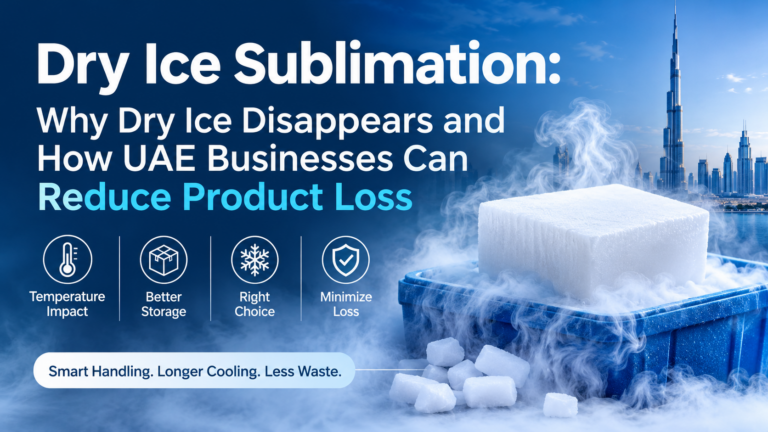
The answer is sublimation. Dry ice gradually changes directly from a solid into carbon dioxide gas when exposed to its surroundings. This natural process means that dry ice loses weight over time, even when it is stored in an insulated container.
For businesses in Dubai and across the UAE, understanding dry ice sublimation is important for planning purchases, reducing unnecessary product loss and managing temperature-sensitive shipments.
What Is Dry Ice Sublimation?
Dry ice is the solid form of carbon dioxide (CO₂), with a temperature of approximately -78.5°C under normal atmospheric pressure.
Unlike regular ice, which melts into liquid water, dry ice changes directly from a solid into gas. This process is known as sublimation.
During sublimation, dry ice gradually becomes smaller and lighter until no solid material remains. The carbon dioxide gas is released into the surrounding environment.
This is why dry ice cannot be stored indefinitely like ordinary frozen water. Even in an insulated container, some sublimation continues over time.
Why Does Dry Ice Disappear So Quickly?
The rate at which dry ice sublimates depends on several storage and environmental conditions. Understanding these factors helps businesses make better decisions when purchasing and handling dry ice.
1. Surrounding Temperature
Temperature plays an important role in dry ice sublimation. When dry ice is exposed to warmer surroundings, it absorbs heat and changes into carbon dioxide gas more quickly.
This is particularly important in the UAE, where outdoor temperatures can become very high during certain months.
Leaving dry ice in direct sunlight, a hot loading area or a vehicle exposed to the sun can increase product loss. Keeping it in a suitable insulated container and away from direct heat helps slow down sublimation.
2. Quality of the Storage Container
The type of container used for dry ice storage can make a significant difference.
A suitable insulated container helps reduce heat transfer from the surroundings. Poorly insulated boxes allow heat to enter more quickly, causing the dry ice to disappear faster.
Businesses that regularly handle dry ice should consider:
- Insulated containers designed for dry ice storage.
- Suitable insulation thickness and construction.
- Containers that are not damaged or exposed to unnecessary heat.
- Storage locations protected from direct sunlight.
The container must also allow carbon dioxide gas to escape. Never use a completely airtight container for dry ice storage.
3. Dry Ice Pellets vs. Blocks
The physical form of dry ice also affects how quickly it sublimates.
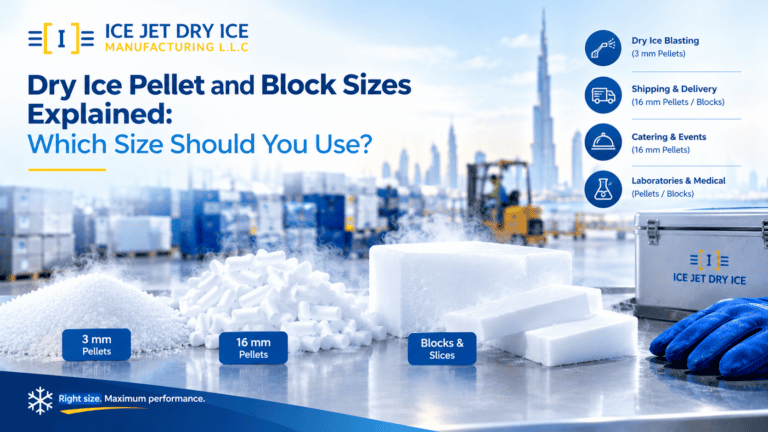
Dry ice pellets have a greater exposed surface area relative to their weight. This allows them to provide cooling across different spaces, but they generally sublimate faster than larger blocks under similar conditions.
Dry ice blocks have less exposed surface area relative to their volume. They generally last longer than pellets when stored under comparable conditions.
Businesses can consider the following differences:
Dry Ice Pellets
- Suitable for applications requiring flexible placement.
- Available in different pellet diameters.
- Useful for filling spaces around suitable packaged products.
- Generally provide faster initial cooling.
Dry Ice Blocks
- Suitable for larger insulated storage arrangements.
- Have a lower surface-area-to-volume ratio.
- Generally sublimate more slowly than pellets of equivalent weight.
- Useful when longer cooling duration is required.
The right choice depends on the application, packaging design and expected transportation time.
For available formats and product options, explore IceJet’s dry ice products.
4. Frequent Opening of Storage Containers
Opening an insulated container repeatedly allows warmer surrounding air to enter.
Every time the lid is opened, the dry ice is exposed to additional heat. This can increase sublimation and reduce the amount available for later use.
For businesses that handle dry ice regularly, it is better to plan the quantity required before opening the container.
Keep the container closed when it is not being accessed and avoid unnecessary inspections.
5. Empty Space Inside the Container
The amount of unused space inside a storage container can also influence cooling efficiency.
A large container with only a small quantity of dry ice may allow more warm air to circulate around the product. Choosing a suitably sized insulated container helps improve storage efficiency.
Packaging should be planned according to the quantity of dry ice, the products being transported and the required temperature conditions.
How Can UAE Businesses Reduce Dry Ice Loss?
Although sublimation cannot be completely stopped, businesses can take practical steps to reduce unnecessary product loss.
Use Suitable Insulated Storage
Choose an insulated container designed for dry ice applications. Avoid leaving dry ice exposed to the surrounding environment for extended periods.
Keep Dry Ice Away from Direct Sunlight
Store dry ice in a shaded, suitable and well-ventilated location. In Dubai and other UAE locations, avoiding unnecessary exposure to outdoor heat is especially important.
Select the Correct Dry Ice Format
Choose pellets or blocks according to the application.
Pellets may be more suitable when flexible placement is needed, while blocks may be preferable when a slower sublimation rate is important.
Plan Your Required Quantity
Estimate the amount needed based on the product, container size, insulation quality and expected storage or transportation duration.
Avoid relying on a fixed quantity for every shipment. Different packaging arrangements and environmental conditions can produce very different results.
For important shipments, conduct packaging tests under realistic conditions and monitor the internal temperature using suitable temperature-monitoring equipment.
Reduce Unnecessary Handling
Keep storage containers closed whenever possible. Organise loading and packing activities in advance to reduce the time dry ice remains exposed to warmer surroundings.
Why Dry Ice Storage Planning Matters in Dubai and UAE
Businesses operating in the UAE often handle temperature-sensitive products across different locations, including warehouses, laboratories, food distribution facilities and logistics centres.
During transportation, several factors can affect dry ice performance:
- High outdoor temperatures.
- Delays during loading and unloading.
- Long transportation distances.
- Different insulation and packaging conditions.
- Frequent access to storage containers.
Without proper planning, businesses may use more dry ice than necessary or face insufficient cooling during transportation.
For a better understanding of packaging and transportation considerations, read our guide on dry ice for shipping in Dubai and the UAE.
Common Dry Ice Storage Mistakes to Avoid
Some common mistakes can increase product loss and create safety risks.
Storing dry ice in airtight containers: Sublimation releases carbon dioxide gas. Pressure can build up inside a sealed container, potentially causing it to rupture.
Handling dry ice with bare hands: Direct contact can cause severe cold burns or frostbite. Always use suitable insulated gloves and appropriate protective equipment.
Keeping dry ice in poorly ventilated spaces: Carbon dioxide can accumulate and displace oxygen. Store and handle dry ice in well-ventilated areas.
Leaving dry ice in direct sunlight: Exposure to heat increases sublimation and reduces the amount of dry ice available for use.
Ordering without considering transportation time: Businesses should account for the complete journey, including loading, transit, delays and unloading.
For more information about storage duration and the factors affecting it, read how long dry ice lasts in an insulated box.
Choosing a Reliable Dry Ice Supplier in Dubai
Selecting the right supplier is an important part of managing dry ice requirements. Businesses should consider product availability, available formats, quantity requirements and delivery arrangements.
IceJet Dry Ice Manufacturing L.L.C. is a Dubai-based dry ice manufacturer and supplier serving businesses across the UAE.
IceJet provides dry ice pellets in different sizes and dry ice blocks for various commercial and industrial applications. These products support requirements across food handling, logistics, pharmaceutical transportation, laboratories, events and other temperature-sensitive operations.
Businesses can discuss their application, required quantity and preferred product format before placing an order.
If your business is looking for a dry ice supplier in Dubai, contact IceJet to discuss your requirements and explore available products.
Frequently Asked Questions
1. Why does dry ice disappear without melting?
Dry ice disappears because it undergoes sublimation. It changes directly from solid carbon dioxide into gas without becoming liquid.
2. What is the temperature of dry ice?
Dry ice has a temperature of approximately -78.5°C under normal atmospheric pressure.
3. Does dry ice sublimate faster in hot weather?
Yes. Higher surrounding temperatures increase the heat transferred to dry ice, which generally accelerates sublimation.
4. Do dry ice blocks last longer than pellets?
Generally, yes. Blocks have a lower surface-area-to-volume ratio than pellets of equivalent weight, so they usually sublimate more slowly under comparable conditions.
5. How can businesses reduce dry ice loss during storage?
Use a suitable insulated container, avoid direct sunlight, minimise unnecessary opening and select the correct dry ice format for the application.
6. Can dry ice be stored in an airtight container?
No. Dry ice releases carbon dioxide gas as it sublimates. Storage containers must allow gas to escape to prevent dangerous pressure build-up.
7. Where can businesses buy dry ice in Dubai?
Businesses can contact IceJet Dry Ice Manufacturing L.L.C. in Dubai to enquire about dry ice pellets, blocks and supply options for commercial and industrial requirements.
Conclusion
Dry ice sublimation is a natural process, but businesses can manage unnecessary product loss through suitable storage, careful handling and proper quantity planning.
Understanding the effects of temperature, insulation, container design and dry ice format helps businesses make more informed purchasing and transportation decisions.
If your business requires dry ice in Dubai or elsewhere in the UAE, contact IceJet Dry Ice Manufacturing L.L.C. to discuss your requirements and explore suitable dry ice products.