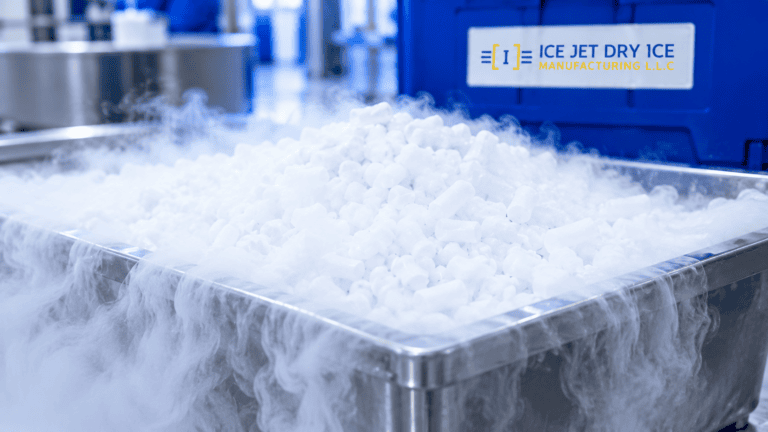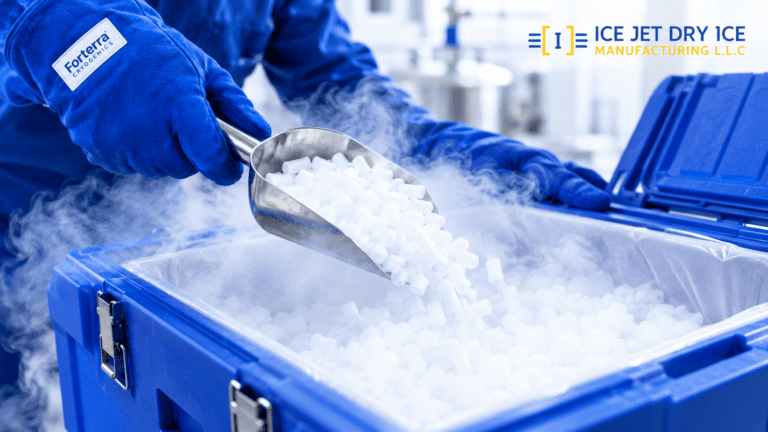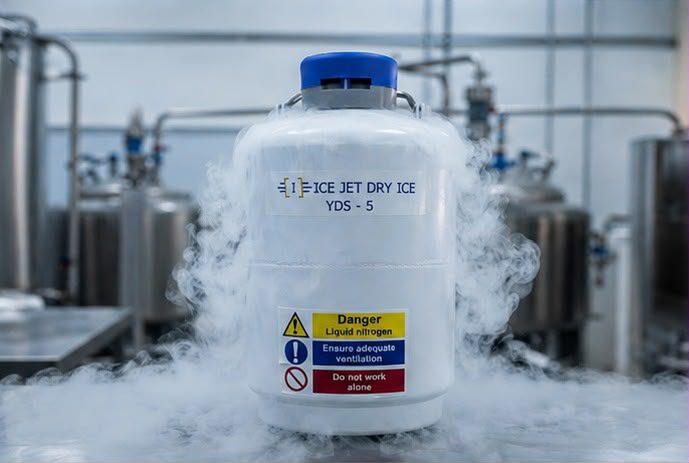
Dry ice is the solid form of carbon dioxide (CO2). It sits at about minus 78.5 degrees Celsius and turns directly into gas instead of melting, so it leaves no liquid behind. It is used for cooling, shipping, fog effects, and industrial cleaning.
That one paragraph answers the question, but there is more worth knowing before you buy or handle it. This guide explains how dry ice works, how it differs from regular ice, what it is used for in Dubai and the UAE, and how to handle it safely.
What Is Dry Ice Made Of?
Dry ice is made from carbon dioxide, the same gas that is in fizzy drinks and the air we breathe out. To make it, CO2 gas is purified, turned into a liquid under pressure, released so that part of it freezes into a snow, and then pressed into pellets or blocks. We explain each stage in our guide to how dry ice is made in the UAE.
Despite the name, dry ice contains no water at all. That is why it is called dry.
How Does Dry Ice Work?
Dry ice works through sublimation. At normal air pressure, solid CO2 does not melt into a liquid. It changes directly from a solid into a gas. As it does, it absorbs a large amount of heat from its surroundings, which is what makes it such a powerful coolant.
Two facts are useful to know:
- It gets very cold. At about minus 78.5 degrees Celsius (minus 109.3 degrees Fahrenheit), it is far colder than the 0 degrees of water ice.
- It expands a lot. One kilogram of dry ice turns into roughly 500 litres of CO2 gas. This is why it should never be sealed in an airtight container.
The white fog you see around dry ice is mostly water vapor from the surrounding air, chilled so quickly by the cold gas that it condenses into a cloud.
Dry Ice vs Regular Ice
- Temperature: dry ice is about minus 78.5 degrees Celsius, regular ice is 0 degrees Celsius.
- What happens as it warms: dry ice turns into gas, regular ice melts into water.
- Mess: dry ice leaves no water or residue, regular ice leaves a wet mess.
- Best for: dry ice suits deep freezing, long shipments, fog effects, and cleaning. Regular ice suits drinks and short term chilling.
If you are deciding between cooling options, read our comparison of dry ice vs traditional ice for transport and our guide to gel ice packs vs dry ice.
Forms of Dry Ice: Pellets, Blocks and Slices
Dry ice is sold in a few shapes, and the right one depends on the job. Smaller pieces cool and disappear faster, while larger pieces last longer.
- 3 mm pellets: typically used for dry ice blasting and cleaning.
- 6 mm and 10 mm pellets: general cooling, packing, and effects.
- 16 mm pellets: popular for shipping, cold chain, and events.
- 20 mm and 30 mm blocks and slices: longer lasting cooling for large boxes and long transport.
What Is Dry Ice Used For?
- Food and delivery: keeping frozen and chilled food safe in transit. See our guide on dry ice for food delivery in Dubai.
- Medical and lab work: transporting samples and temperature sensitive materials. Read more on dry ice for the medical industry.
- Shipping and logistics: holding goods at very low temperatures over long distances. Our article explains the rules for flying or shipping dry ice from Dubai.
- Events and weddings: creating thick low fog and special effects. See how much dry ice you need for an event.
- Industrial cleaning: dry ice blasting cleans machinery without water or chemicals. Learn what dry ice cleaning can and cannot clean.
Is Dry Ice Dangerous?
Dry ice is safe when handled correctly, and risky when it is not. It is not poisonous, but it can cause harm in three ways: cold burns, gas buildup, and pressure.
- Do not touch it with bare hands. Contact can cause a cold burn in seconds. Use insulated or cryogenic gloves.
- Keep the space ventilated. As dry ice turns to gas, CO2 can build up in small or closed spaces, including a closed car, and reduce the air you can breathe.
- Never seal it in an airtight container. The expanding gas can build pressure.
- Do not swallow it or put pieces in drinks that people will drink.
- Keep it away from children.
- Avoid storing it in a home freezer. It is colder than the freezer is designed for.
For more detail, read our guide on how to safely store and handle dry ice in the UAE and our article on cryogenic gloves and dry ice safety gear.
How Long Does Dry Ice Last?
Dry ice begins to turn into gas the moment it is made, so it cannot be stored forever. How long it lasts depends on its size, how well it is insulated, and the surrounding heat. In hot weather it disappears faster, and larger blocks in a good insulated container last the longest. Our guide on how long dry ice lasts in an insulated box goes into this in detail.
Common Myths About Dry Ice
- “Dry ice is just frozen water.” It is frozen carbon dioxide and contains no water.
- “The fog is poisonous.” The fog itself is mostly water vapor, but the CO2 gas around it can displace air in enclosed spaces, which is why ventilation matters.
- “You can stock up and keep it for weeks.” It sublimates continuously, so it is best ordered close to when you need it.
Where to Buy Dry Ice in Dubai
Because dry ice disappears over time, the best place to buy it is from a producer close to you that makes it fresh. Ice Jet Dry Ice Manufacturing LLC produces dry ice in Al Quoz Industrial Area, Dubai, and supplies pellets, blocks and slices across Dubai and the UAE. You can browse the full range on our dry ice products page, read our buyer’s guide to dry ice suppliers in Dubai and the UAE, or visit our dry ice Dubai page.
When you are ready to order, contact us with the quantity, form, location and date you need, and we will confirm availability and delivery timing.
Frequently Asked Questions
Q. What is dry ice in simple words?
Dry ice is frozen carbon dioxide. It is extremely cold and turns straight into gas instead of melting into water.
Q. Is dry ice the same as regular ice?
No. Regular ice is frozen water at 0 degrees Celsius. Dry ice is frozen CO2 at about minus 78.5 degrees Celsius, and it does not melt.
Q. Why is it called dry ice?
It is called dry because it does not melt into a liquid. It goes directly from solid to gas and leaves no water behind.
Q. Is dry ice safe to touch?
No. Touching it with bare skin can cause a cold burn almost immediately. Always use insulated or cryogenic gloves.
Q. Can dry ice be put in a drink?
It is not recommended. Pieces can cause injury if swallowed, so dry ice should not go into drinks that people will drink.
Q. How cold is dry ice?
About minus 78.5 degrees Celsius, or minus 109.3 degrees Fahrenheit.
Q. Can I buy dry ice in Dubai?
Yes. Dry ice is available from local producers in Dubai. Choose one that makes it fresh and can confirm delivery timing for your location.
Need dry ice in Dubai or the UAE? Contact IceJet UAE for pellets, blocks and slices, and we will confirm availability for your order.